About South Clyde Energy Centre
What is South Clyde Energy Centre?
The South Clyde Energy Centre is an Energy from Waste facility
currently under construction on land adjacent to Bogmoor Road,
North Cardonald, Glasgow. Every year, the centre will recover
energy by processing around 350,000 tonnes of residual and
commercial waste that would otherwise go to landfill or be
exported. This residual waste will have already been sorted to
remove valuable recyclables, such as glass, metal, plastic, paper
and card.
It is a clean and safe way of treating waste that cannot
economically or practically be recycled.
Why is the facility needed?
Scotland generates over 10 million tonnes of waste each year -
this includes waste from households, businesses, and public
services. At the end of 2025, the Scottish Government are
introducing a landfill ban, meaning biodegradable municipal waste
(BMW), can no longer be landfilled in Scotland. Current
SEPA
figures show 1.81 million tonnes of waste was sent to landfill in
2023 - that's 19.0% of all waste generated.
With landfill no longer being an option, facilities like the South
Clyde Energy Centre will provide much needed waste processing
capacity within Scotland. It will also recover energy safely and
cleanly from waste to generate electricity, which will then be
used by homes and businesses.
What are the benefits of the South Clyde Energy Centre?
Once operational the facility will:
-
Generate up to 45 MWe (megawatts electric) of energy, enough to
power the equivalent of around 90,000 homes.
-
Provide approximately 500 construction jobs and around 40 new,
permanent jobs once the site is operational.
-
Create supply chain opportunities for a wide range of local
suppliers.
-
Each year, the centre will divert around 350,000 tonnes of
residual waste which would otherwise go to landfill or be
exported.
-
Help deliver the Scottish Government's landfill ban, which comes
into effect at the end of 2025.
-
Have the potential to supply nearby commercial and industrial
users with the surplus heat generated.
-
Enable residues from the combustion process (Incinerator Bottom
Ash) to produce secondary aggregates for the production of
concrete products.
-
Contribute to Scotland and the UK's drive to reduce carbon
dioxide emissions from electricity generation.
Does the facility have planning consent?
Yes. You can view the full details of the planning application on
the
Glasgow City Council website. The planning consent reference number is: 12/01293/DC
The original planning consent was granted to Peel Environmental in
2012. Fortum Glasgow acquired the site from Peel in 2019. In
December 2022, the project applied to Glasgow City Council for a
variation to the existing planning consent. This variation
application is in regard to some small design changes to the main
building which will not affect the overall visual impact or height
of the facility in any way.
Who owns the project and who is developing it?
The centre is being developed by Fortum Glasgow Ltd, which is
jointly owned by Fortum and
Gren.
Who are Fortum?
Fortum is a Nordic energy company. Fortum generates and delivers
reliable energy to its customers and the Nordic energy system
while at the same time helping industries decarbonise their
processes and grow. The company's core operations comprise
efficient and best-in-class low-carbon power generation, customer
services, and heating and cooling. Fortum's power generation is
99% from renewable or nuclear sources with one of the lowest
specific CO2-emissions in Europe.
Who are Gren?
Gren develops and delivers energy solutions, ranging from
sustainable district heating, to renewable and industrial energy,
to meet the daily needs of its customers and communities. With an
extensive track record in the Baltics, Gren entered the UK market
in May 2023 when it acquired a network of combined heat and power,
energy from waste and biomass assets.
Gren's core focus is on developing long-term infrastructure
solutions that can serve anchor institutions, unlock private
investment, reduce energy bills and rapidly increase the
development of district heating infrastructure across the UK. It
harnesses technology, already used extensively in towns and cities
in mainland Europe, to deliver the most cost-effective route to
decarbonisation for urban areas.
Why have you chosen this location?
In 2019, Fortum Glasgow acquired the site from Peel Environmental,
which had been granted planning permission for the facility in
2012. The disused, industrial site, which had previously been used
for the storage and processing of inert wastes and aggregates, is
brownfield land and is very close to both the M8 and A8.
What is an Energy from Waste (EfW) facility?
An Energy from Waste facility is a sustainable method of dealing
with waste that would otherwise go to landfill. Rather than
burying waste in the ground where it emits greenhouse gases and
leaches toxic substances into the soil, waste is instead treated
as a resource that can be used to create power and heat.
Are there other waste facilities like this in Scotland?
Yes. Energy from Waste facilities are not a new concept and there
are many similar facilities already operating throughout Scotland
and the UK, with 63 operational facilities across the UK in 2024.
Do Energy from Waste facilities mean less recycling is needed?
No. The facility will process the waste left over after all
commercially viable recyclable material has been removed. South
Clyde Energy Centre will transform nonrecyclable waste from
Glasgow and other areas of the country into low-carbon heat and
power that will benefit local homes, hospitals, universities, and
industries. This not only ensures responsible waste management but
also contributes meaningfully to Glasgow's broader sustainability
and climate goals
Construction of the Facility
Who will construct the facility?
AFRY has been appointed Engineering, Procurement and Construction
Management (EPCM) consultant for the project and will provide
services for site supervision throughout the construction and
start-up of the project. Kanadevia Inova (KVI) will design, build
and commission the grate and boiler for the new facility. Doosan
Skoda Power has been commissioned to supply the steam turbine,
including the air-cooled condenser, and Luehr Filter will supply
the flue gas treatment plant.
During the construction of the facility, we aim to source goods
and services from local suppliers wherever possible. For more
information on becoming a potential supplier, please visit
https://www.southclydeenergycentre.co.uk/#procurement.
What is the construction programme?
Construction and demolition work started towards the end of 2022.
The plant is expected to be operational in late 2026.
What are the working hours during the construction phase?
Construction operations will generally take place between the
following working hours:
07:00-19:00 Monday to Friday
07:00-12:00 Saturday
It is possible that some quieter construction activities may take
place outside these hours.
Will there be a lot of construction traffic?
A detailed transport assessment was undertaken for the original
planning application. This assessment showed that the traffic
generated by the facility would not have any significant effects
on the local highway network in terms of capacity or safety.
Transport assessments such as these take into consideration staff
cars as well as deliveries and any other construction related
traffic.
An HGV routing strategy has been developed, so that all HGV
traffic associated with the facility must use the A8 corridor to
reach junctions 25 and 26 of the M8. All construction contractors
will be required to abide by this routing strategy and compliance
will be monitored.
HGV movements will not take place outside normal working hours
without prior agreement from Glasgow City Council.
How do you plan to work with the local community?
It is our aim to be a good neighbour, establishing good
relationships with the community and local businesses. One of the
key ways we will do this is via a Local Liaison Committee. We will
also keep this website updated with the latest construction news
and, if you have any concerns, you can contact us via email:
info@southclydeenergycentre.co.uk.
Will the construction phase be noisy?
There will be strict limits on noise during the construction
phase. We will always do our best to minimise any disturbance and,
whenever possible, we will communicate with our neighbours and
update the website in advance of any potential noisy works. If you
have any concerns, please contact us via email:
info@southclydeenergycentre.co.uk
Do you have a plan in the event of an environmental emergency?
Before starting work on site, all staff will undergo a
comprehensive health and safety induction, which will include a
general overview of site specific environmental issues, as well as
details on how these should be managed.
There will be regular environmental briefings, and toolbox talks
for all staff to ensure everyone on site has the most up-to-date
information. These will be supplemented with environmental
bulletins and 'newsflashes' in amenity and office areas.
All visitors to site will be provided with an appropriate health
and safety induction. The site will also have a site emergency
plan in case of a serious incident.
Jobs and Suppliers
What will be done to encourage local people to apply for
positions?
Our intention is to maximise the use of local labour wherever it
is possible to do so. We aim to recruit skilled people from the
local area, notwithstanding the specialist nature of some of the
equipment and machinery utilised by the project.
If you are interested in a role during the construction of the
South Clyde Energy Centre, please submit your CV via email:
info@southclydeenergycentre.co.uk
Once construction is complete there will be around 40 new,
permanent operational roles at the facility. These roles will be
advertised and recruited locally by the operator of the new
facility. Recruitment has begun for these permanent roles and
details can be found here
South Clyde Energy Centre Jobs | Energy Jobs Scotland
What are the expected numbers of people working on site during
construction?
The number of workers on site will fluctuate over time but it is
anticipated there will be around 500 jobs during the construction
phase. The types of jobs will range widely across different
trades, with different skills being required at different times.
If you are interested in potential employment opportunities during
the construction phase, please submit your CV via email:
info@southclydeenergycentre.co.uk
What commitment is there to source goods and services from local
suppliers?
There will be multiple supply chain opportunities for local
businesses throughout the construction phase. Many subcontractors
will be required during the construction of the facility, ranging
from canteen services to engineering and construction, office
materials, transport services and accommodation.
What aspects of the project will be from overseas?
Many elements of the project, including a very high proportion of
the civils works, will be predominantly delivered by UK companies.
However, some aspects of the project will be sourced from outside
of the UK.
The technology used in Energy from Waste facilities is not always
available in the UK and there is often a lack of industrial
manufacturing capacity for the type of components required.
Consequently, the design of the plant and many of the technical
components will come from specialist companies outside the UK.
There will, however, be opportunities for suppliers to maintain
and service the facility throughout its operational life.
Operations
How will the Energy from Waste facility work?
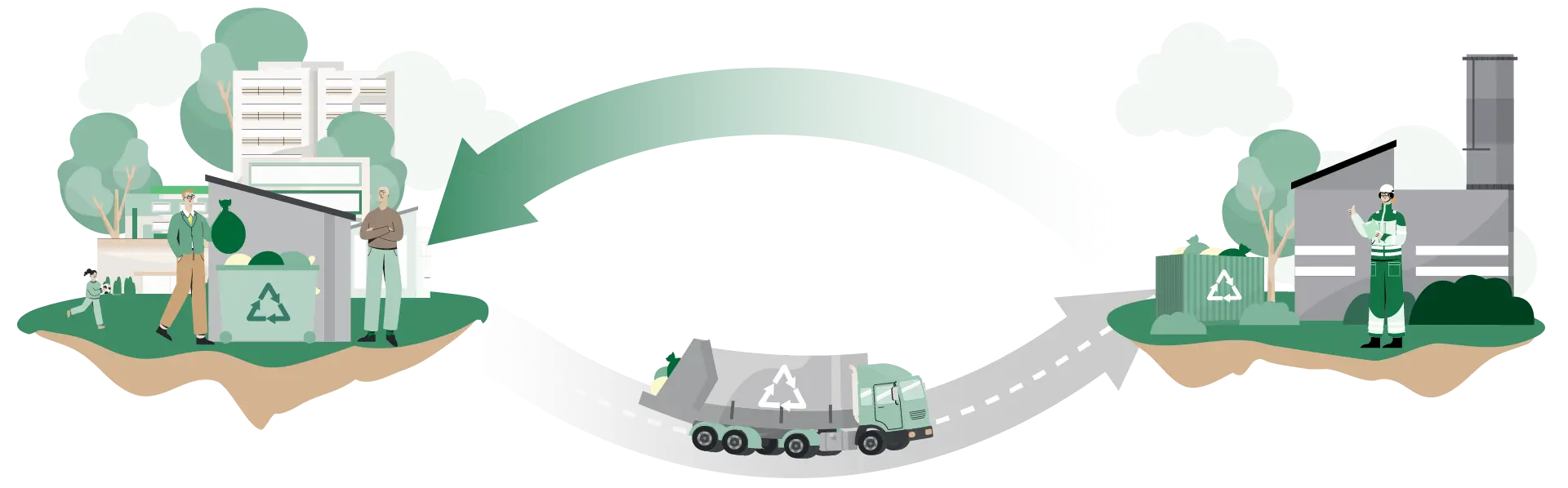
Waste that cannot be economically or practically recycled will be
transported by enclosed HGVs to the South Clyde Energy Centre
where it will be stored within a bunker.
Waste from the bunker is put into a fuel hopper by a crane and
transferred onto a moving grate where the waste is treated at high
temperatures.
Hot air created from the combustion process passes through a
boiler, converting water into high pressure steam. This steam
drives a highly efficient turbine to produce electricity.
The electricity generated is exported to the local electricity
distribution system to be used by homes and businesses. Subject to
a suitable local offtaker, some of the steam created by the
process could be used to heat nearby homes or businesses.
By-products such as ash and metals can be reused and recycled. For
example, ash will be recycled for use as an aggregate in
construction.
All emissions from the process are continuously monitored and,
where required, treated to meet strict air quality standards as
set out within the site's environmental permit.
Operational staff in the control room will monitor and manage the
whole process end-to-end to ensure a safe, efficient and compliant
operation.
How much energy will the facility generate?
The facility will generate 45 MW of electricity, enough to power
the equivalent of around 70,000 homes. It is also possible to
generate heat that can be used by nearby homes or businesses.
What types of waste will be accepted?
The facility will accept post-recycled, pre-treated, non-hazardous
residential, commercial and industrial waste.
How will you protect local air quality?
The South Clyde Energy Centre will be subject to a strict
environmental permit issued and regulated by the Scottish
Environment Protection Agency (SEPA). We will use advanced
controls and continuous emissions monitoring technology to make
sure air emissions meet stringent modern standards, as set out in
the environmental permit.
As part of the Environmental Impact Assessment (EIA) prepared to
support the planning application, a detailed assessment of the
potential effects on air quality was carried out, looking at
emissions from the stack, as well as the impact of HGVs visiting
the facility.
During operation, the facility will use CEMS – Continuous
Emissions Monitoring System – which will use probes in the flue
gas stack to continuously monitor the flue gas emissions. The
facility will operate under the strict permit conditions set out
by SEPA, which has legal powers to halt operation of the plant and
/ or prosecute any organisation that is not operating within the
conditions set out in the facility's environmental permit. Energy
from Waste facilities are not allowed to begin operations unless
they can meet the conditions set out in the environmental permit.
Will the facility impact local ecology?
No. The environmental impact of the facility has been carefully
assessed through an Environmental Impact Assessment (EIA) and the
facility will not harm the local habitat or the wildlife that use
it.
Will the facility be noisy?
No. The facility's design means that almost all activity will take
place indoors and therefore any noise impact on the wider area
will be insignificant.
Background noise monitoring has been carried out and the data used
to assess the potential noise effects of the facility, in line
with published standards and guidance. This information was
provided as part of the Environmental Impact Assessment (EIA)
which accompanied the planning application.
Will it create more traffic?
A detailed transport assessment was undertaken for the original
planning application. This assessment showed that the traffic
generated by the facility would not have any significant effects
on the local highway network in terms of capacity or safety.
Transport assessments such as these take into consideration staff
cars as well as deliveries and any other operations-related
traffic.
An HGV routing strategy will be developed so that all HGV traffic
associated with the facility must use the A8 corridor to reach
junctions 25 and 26 of the M8. This HGV routing strategy will be
enforced by a range of monitoring and enforcement measures.
How will you be a good neighbour?
As well as creating local jobs and investment, we intend to
establish a Local Liaison Committee which will gather feedback and
opinions from local residents and provide information to the
community during the construction phase. It will meet on a regular
basis, with the aim of ensuring the project proceeds with minimal
impact and disruption to the local community.
Will there be an impact on carbon dioxide levels?
The carbon impacts of the South Clyde Energy Centre have been
comprehensively assessed. Compared with landfilling, the South
Clyde Energy Centre is expected to reduce greenhouse gas emissions
by 67 kt CO2e per year.
South Clyde Energy Centre also has the potential to be retrofitted
with Carbon Capture Utilisation and Storage (CCUS) technology in
the future, aligning it with the requirements of the Scottish
Government's Climate Change Plan.
Once operational, will the facility cause a smell?
Every step is taken to minimise the likelihood of odour including:
-
Waste will be delivered in covered vehicles and deposited
indoors.
-
Fast acting shutter doors will be fitted to the tipping hall.
-
Waste will be stored inside: i.e. within enclosed buildings.
-
The waste reception and tipping hall / waste bunker, will be
kept under negative pressure by extracting air using an induced
draft (ID) fan. This air will be drawn into the furnace and into
the combustion process.
-
An odour abatement system (also known as an odour extraction
system) utilising carbon filtration will be used for periods
when the plant is shut down for maintenance or other outage
events.
Who will regulate the plant?
The South Clyde Energy Centre will be regulated by the Scottish
Environment Protection Agency (SEPA), which uses strict
regulations to ensure that the operator controls and monitors
emissions and operations on a constant basis. SEPA has legal
powers that enable it to halt operation of a facility and / or
prosecute any organisation that is not operating within the
conditions set out in the facility's environmental permit.
In addition, the monitoring system includes safeguards to halt
operation in the event that the conditions of the environmental
permit are not likely to be met. Facilities are not allowed to
begin operating unless they can meet - and continue to prove they
are meeting - the conditions set out in the environmental permit.
Who will monitor the facility for safety and compliance?
The SEPA will enforce safety standards for the lifetime of the
facility. SEPA carries out regular checks on the facility, some of
them unannounced. It also has the power to close the facility if
it believes it is not operating correctly. On site, emissions from
the stack will be monitored continuously to ensure they comply
with the emissions levels set within the environmental permit and
emissions data will be collected as part of the conditions of the
environmental permit.
If the emission levels start to rise, it will be detected by the
Continuous Emissions Monitoring System (CEMS) and the Distributed
Control System (DCS), and operators will make adjustments to the
plant's operations to maintain compliance with the environmental
permit.
What comes out of the stack?
The main components are water vapour, carbon dioxide, nitrogen and
oxygen, with small trace elements of pollutants that are below the
limits set out in the environmental permit.
Is this a renewable energy facility?
While this is not a renewable facility, it recovers energy from
waste that would otherwise be sent to landfill or exported.
What is an Environmental Impact Assessment?
An Environment Impact Assessment (EIA) assesses the environmental
impact of a development and considers all potential effects on the
human and natural environment. If the potential impact is
negative, developers have to undertake measures to reduce or
offset the impact.
How do I sign up for updates on the project?
Please complete the form
here to sign up to our
newsletter.